

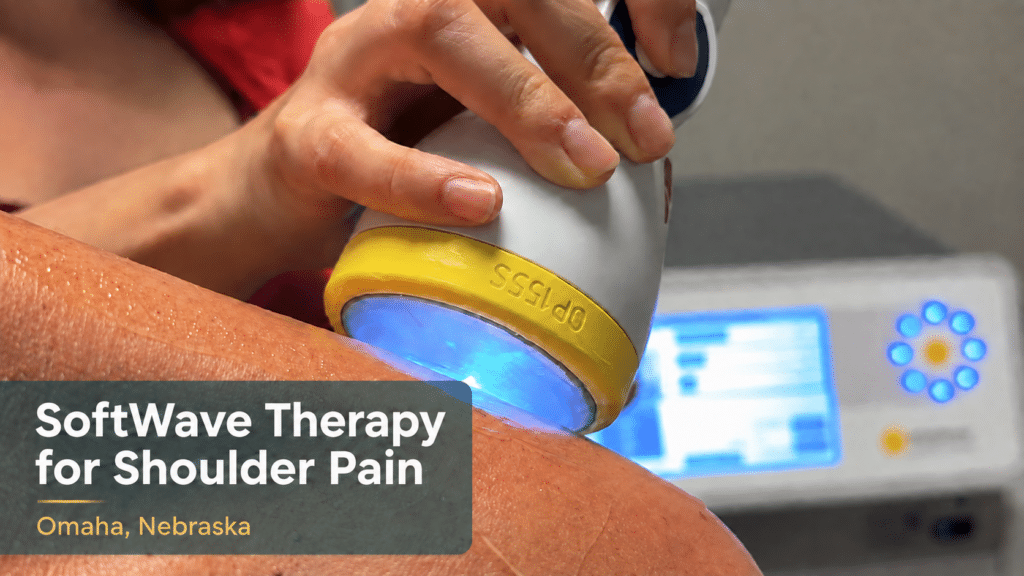
SoftWave Therapy in Omaha, Nebraska
When pain limits work, sleep, exercise, or the activities you love, meaningful improvement can feel life-changing. For Dr. Jason Wiese, the owner of Life Source Chiropractic in Omaha, a shoulder replacement appeared to be the next step—until he decided to try one more nonsurgical option.
SoftWave Therapy is a noninvasive form of extracorporeal shockwave therapy. It sends acoustic pressure waves into an area of painful or injured tissue. The SoftWave OW100S is FDA-cleared for the relief of minor muscle aches and pains, a temporary increase in local blood circulation, and activation of connective tissue. Research has evaluated shockwave therapy for a number of tendon, fascia, muscle, bone, and joint-related problems, but results and the strength of evidence vary by condition.
SoftWave Therapy for Shoulder Pain: Dr. Wiese’s Story
Dr. Wiese was dealing with severe shoulder pain and limited function. Imaging showed Grade IV chondromalacia and advanced glenohumeral arthritis with a large area of cartilage loss. He had tried multiple approaches, but the pain continued. He describes it as an 8 out of 10 at its worst.
Shoulder replacement seemed to be next. The expected four-to-six-month recovery was not in the cards for him, and surgery would still mean accepting significant recovery time and uncertainty about his individual outcome. He wanted to explore every reasonable option before making that decision. That search led him to SoftWave Therapy.
In the video above, Dr. Wiese explains that his pain later decreased to approximately a 2 out of 10 and that he was able to return to activities he enjoys, including golf. His experience is personal—it does not guarantee the same result for someone else—but it is the reason he chose to bring SoftWave Therapy to Life Source Chiropractic.
SoftWave is designed to stimulate a biological response that supports the body’s natural healing process. The technology is FDA cleared for activation of connective tissue, improvement in local blood circulation, and relief of muscle aches and pains.
What is SoftWave Therapy?
SoftWave is a brand of electrohydraulic extracorporeal shockwave therapy, often shortened to ESWT. “Extracorporeal” simply means the energy is generated outside the body. During a treatment, gel is applied to the skin and a handheld applicator delivers acoustic pressure waves into the targeted area.
This is not surgery, an injection, or a medication. It also is not the same as a massage gun or therapeutic ultrasound. SoftWave’s applicator is designed to distribute acoustic energy over a broad treatment zone, allowing the clinician to assess an area and adjust treatment based on the patient’s feedback.
According to the manufacturer’s FDA-clearance information, the OW100S is intended for relief of muscle aches and pains, improvement in local circulation, and activation of connective tissue. Those are the relevant general musculoskeletal uses. Separate FDA clearances for certain wounds and burns are not the focus of the care described in this article.
How may SoftWave help?
The acoustic waves provide a controlled mechanical stimulus to the treatment area. Researchers often describe the tissue’s response through a process called mechanotransduction: cells convert a mechanical signal into biological activity.
Laboratory and clinical research suggests that shockwave therapy may influence local circulation, connective-tissue activity, pain signaling, and other processes involved in tissue repair. The exact mechanisms are still being studied, and “stimulating a healing response” should not be interpreted as a promise to regrow cartilage or cure an underlying condition.
For many patients, the practical goals are straightforward: reduce pain, improve movement, and help them participate more comfortably in rehabilitation or daily activity. SoftWave may be used as one part of a broader care plan rather than as a replacement for every other form of care.
What conditions may be evaluated for SoftWave Therapy?
Research on extracorporeal shockwave therapy has included a range of musculoskeletal problems. At Life Source Chiropractic, a provider first evaluates the person and the painful area to decide whether SoftWave is appropriate. Conditions commonly discussed include:
- Shoulder pain, including certain rotator-cuff and calcific tendon problems
- Plantar fasciitis and persistent heel pain
- Achilles and patellar tendinopathy
- Tennis elbow and golfer’s elbow
- Hip, knee, and other joint-related pain, including some osteoarthritis-related symptoms
- Muscle strains and overuse injuries
- Sports-related soft-tissue pain and areas that have not responded as expected to rest or rehabilitation
The evidence is not equally strong for every diagnosis. For example, studies of shoulder conditions differ depending on whether the problem involves calcific tendinopathy, another rotator-cuff disorder, frozen shoulder, or arthritis. A proper evaluation matters because similar symptoms can have different causes—and some symptoms require imaging, medical referral, or a different treatment approach.
You can also read more about shoulder pain and sports chiropractic care at Life Source Chiropractic.
Why is shockwave therapy used in sports medicine?
Shockwave therapy has become a familiar tool in sports medicine because it is noninvasive, can be delivered in an outpatient setting, and may be incorporated alongside rehabilitation. A 2021 sports-medicine review discussed ESWT for conditions such as rotator-cuff tendinopathy, tennis elbow, patellar and Achilles tendinopathy, plantar fasciopathy, and certain bone-stress injuries. A later systematic review evaluated its use in athletes and physically active people while also noting that treatment protocols and evidence quality differ across conditions.
SoftWave Technologies reports that its devices are used by professional and collegiate sports organizations across the NFL, NCAA, MLB, NBA, NHL, MLS, and other leagues. Independent SoftWave provider materials also list the University of Nebraska–Lincoln among collegiate users and numerous NFL organizations among professional users.
That reported use is useful context, but it is not an endorsement of Life Source Chiropractic by the University of Nebraska, the NCAA, the NFL, or any individual team. Professional adoption also does not prove that the therapy is right for every patient. The more important question is whether the treatment fits a person’s diagnosis, health history, and goals.
What should you expect at a SoftWave appointment?
Your visit should begin with a conversation about your symptoms, history, prior care, and goals. The provider may examine movement and tenderness and screen for reasons that SoftWave may not be appropriate. If treatment is suitable, gel is applied and the applicator is moved across the target area while acoustic waves are delivered.
People often describe the sensation as tapping or pressure. Tender areas may feel more intense, and the provider can adjust the settings. The number of visits depends on the condition, how long it has been present, and how the person responds. A single discovery treatment can provide useful information, but it cannot predict or guarantee a full outcome.
Frequently asked questions
Is SoftWave the same as shockwave therapy?
SoftWave is a specific electrohydraulic shockwave-therapy technology. “Shockwave therapy” is a broader category that includes devices with different ways of generating and delivering acoustic energy. Devices and protocols should not be assumed to be identical.
Can SoftWave help shoulder arthritis?
SoftWave does not replace lost cartilage or remove arthritis. Some people with osteoarthritis-related pain may be evaluated for treatment with the goal of reducing symptoms and improving function. The likely benefit depends on the source and severity of the pain, so an individual assessment is important.
Is there downtime after treatment?
SoftWave is noninvasive, and many people return to normal daily activity after an appointment. Recommendations can vary according to the tissue treated, symptom severity, and the rest of the care plan.
How many SoftWave treatments will I need?
There is no universal number. Recommendations depend on the condition, its duration, treatment goals, and response to care. Your provider should explain the proposed plan and reassess progress rather than guarantee a set result.
Where is SoftWave Therapy available in Omaha?
Life Source Chiropractic provides SoftWave Therapy at 15475 Ruggles Street, Suite 110, Omaha, Nebraska 68116. The office serves Omaha, Bennington, Elkhorn, Northwest Omaha, Waterloo, Valley, and nearby communities.
Find out whether SoftWave is appropriate for you
If pain is keeping you from work, sleep, exercise, or the activities you enjoy, schedule a SoftWave Discovery Treatment with Life Source Chiropractic.
Life Source Chiropractic
15475 Ruggles Street, Suite 110
Omaha, NE 68116
(402) 934-4220 · (Request an appointment)
Important: Individual results vary. Patient experiences are testimonials, not guarantees. This article is for educational purposes and is not a substitute for diagnosis or individualized medical advice. Seek prompt medical care for a new traumatic injury, deformity, sudden weakness, chest pain, shortness of breath, or other urgent symptoms.
Sources and further reading
- SoftWave Tissue Regeneration Technologies: FDA Clearances.
- Schroeder AN, Tenforde AS, Jelsing EJ. Extracorporeal Shockwave Therapy in the Management of Sports Medicine Injuries. Current Sports Medicine Reports. 2021;20(6):298–305.
- Rhim HC, et al. Use of extracorporeal shockwave therapies for athletes and physically active individuals: a systematic review. British Journal of Sports Medicine. 2024.
- SoftWave Technologies: Sports Medicine (source for manufacturer-reported league use).
- Restore Lab: SoftWave Therapy (independent provider-reported list that includes Nebraska and professional organizations).