

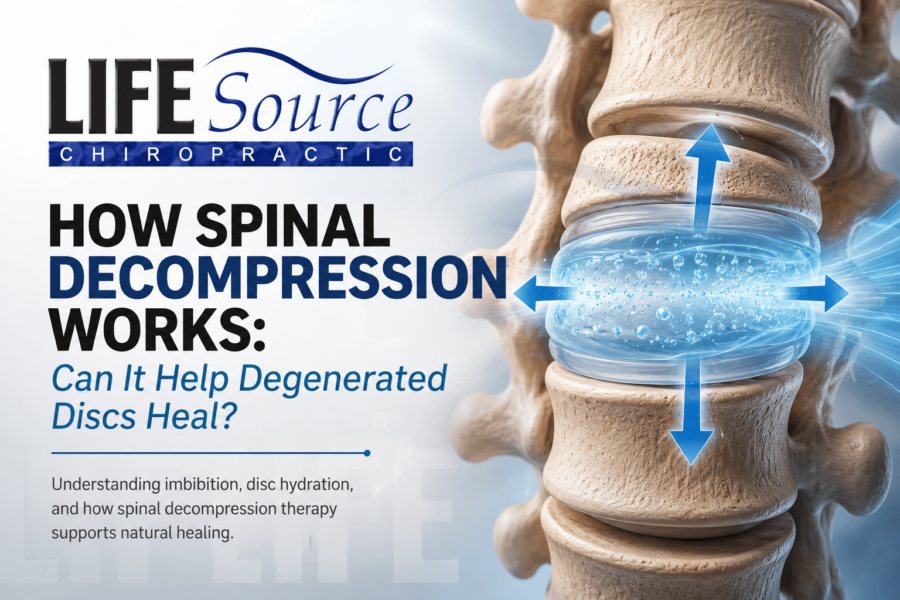
If you’ve been told you have a bulging disc, herniated disc, or degenerative disc disease, you’ve probably wondered one thing:
Can a damaged spinal disc actually heal?
The answer is yes—to a point. It also depends on what is causing the problem. While no treatment has been proven to completely reverse advanced disc degeneration, spinal discs are living tissues that can improve their hydration and health when they’re given the right environment.
One of the most important concepts behind disc health is imbibition—the natural pumping mechanism that allows spinal discs to receive water and nutrients.
This is one of the primary reasons we use spinal decompression therapy as part of the Paragon Method at Life Source Chiropractic in Omaha.
In this article, you’ll learn how disc degeneration develops, what imbibition is, how spinal discs receive nutrients, and what current research says about spinal decompression therapy.
Understanding the Anatomy of a Spinal Disc
Your spine is made up of bones called vertebrae.
Between each vertebra sits an intervertebral disc, which acts like a shock absorber.
Each disc has two main parts:
- Nucleus Pulposus – the soft, gel-like center that provides cushioning.
- Annulus Fibrosus – the strong outer rings that contain the nucleus.
Unlike muscles or skin, spinal discs have very little direct blood supply.
That means they cannot simply receive nutrients through arteries like most tissues in the body.
Instead, they rely on movement.
What Is Imbibition?
Imbibition is the process by which spinal discs absorb water, oxygen, nutrients, and remove waste products.
Think of a spinal disc like a sponge.
When pressure is applied, the sponge is compressed and fluid is pushed out.
When pressure is removed, the sponge expands and fresh fluid is drawn back in.
Your spinal discs work in a very similar way.
Every time your spine moves normally:
- The disc is gently compressed.
- Fluid is pushed out.
- When the pressure decreases, fresh fluid containing water and nutrients is drawn back into the disc.
This constant pumping action helps keep discs:
- Hydrated
- Flexible
- Strong
- Better able to absorb shock
Without this natural cycle, discs gradually begin to lose water, elasticity, and their ability to withstand everyday stresses.
Why Spinal Discs Need Movement to Stay Healthy
One of the most fascinating facts about spinal discs is that they have very little direct blood supply.
Unlike muscles, skin, or other tissues, the center of an intervertebral disc does not receive nutrients through arteries carrying blood directly into it.
Instead, nutrients such as oxygen and glucose must diffuse through the cartilage endplates of the vertebrae and into the disc. Waste products travel back out the same way.
Because of this unique anatomy, movement is essential.
Every time you bend, walk, stretch, or move your spine normally, pressure inside the disc changes. These pressure changes create the pumping action that allows nutrients to enter the disc while metabolic waste is removed.
Without adequate movement, this diffusion process becomes less efficient, and the disc’s cells receive fewer of the nutrients they need to maintain healthy tissue.(1)
How Disc Degeneration Happens
Many people believe disc degeneration is simply an unavoidable part of aging.
While aging certainly plays a role, loss of normal spinal motion is often one of the major contributors.
When spinal joints stop moving normally because of:
- Poor posture
- Previous injuries
- Repetitive stress
- Joint restriction
- Disc injuries
- Muscle imbalance
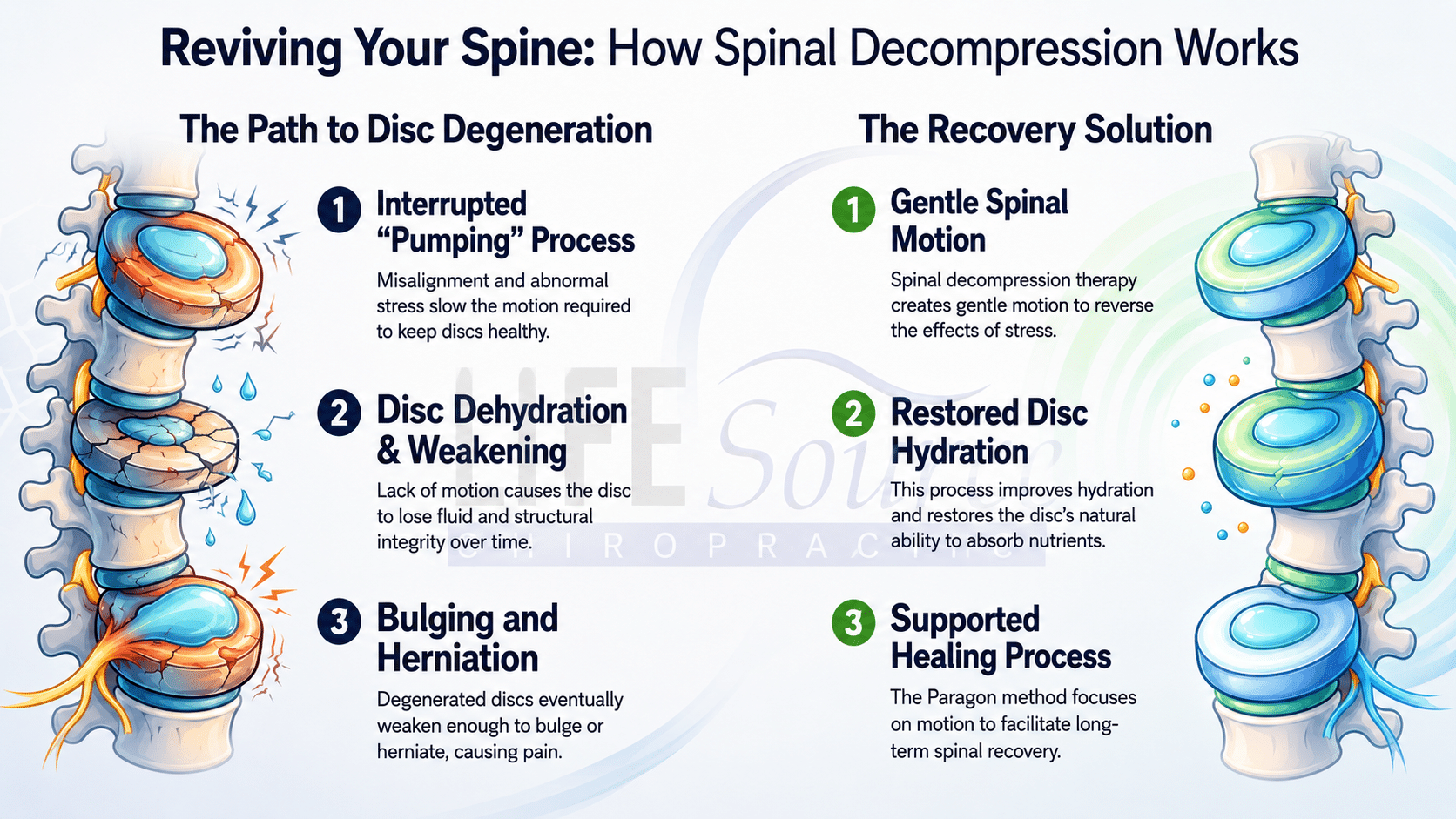
…the disc’s natural pumping mechanism slows down.
Without normal movement:
- Less water reaches the disc.
- Fewer nutrients diffuse into the disc.
- Cellular waste products accumulate.
- The disc gradually becomes dehydrated.
As hydration decreases, the disc begins to lose height and flexibility.
Over time, the outer fibers of the disc become weaker and more susceptible to small tears. This can eventually contribute to:
- Bulging discs
- Herniated discs
- Degenerative disc disease
- Increased stress on the spinal joints
- Nerve irritation
This process typically develops gradually over many years rather than occurring overnight.
How Spinal Decompression Works Inside the Disc
Spinal decompression therapy is a specialized treatment that applies a precise, computerized distraction force to the spine.
Unlike simply hanging upside down or stretching, spinal decompression alternates between carefully controlled phases of distraction and relaxation.
This creates several important biological effects.
1. Reduces Pressure Within the Disc
Research has shown that spinal decompression can lower pressure inside the intervertebral disc. (5) Reducing this pressure may help decrease mechanical stress on injured disc tissue while reducing irritation around compressed spinal nerves.(2)
2. Supports the Process of Imbibition
Perhaps the most important benefit of spinal decompression is its ability to help restore the disc’s natural fluid exchange.
During treatment:
- Pressure inside the disc decreases.
- The disc is allowed to gently expand.
- Water can move back into the disc.
- Oxygen and nutrients can diffuse through the vertebral endplates.
- Cellular waste products can be removed.
In essence, spinal decompression helps recreate the natural pumping mechanism that healthy spinal discs depend upon.
Rather than forcing nutrients into the disc, spinal decompression creates an environment that allows the disc’s normal nutrient exchange process to function more effectively. (1) (2)
3. Research Shows Improvements in Disc Hydration
Emerging research has begun to demonstrate measurable biological changes following traction-based spinal decompression therapies.
In one MRI study using advanced T2 mapping, researchers found that patients with mild to moderate disc degeneration demonstrated increased water content within the nucleus pulposus after a series of lumbar traction treatments. Improvements in disc hydration were also associated with reductions in pain and disability scores.(1)
Additional MRI and CT studies have demonstrated increases in disc height following spinal decompression, suggesting that reducing intradiscal pressure may temporarily restore disc space and improve the environment for disc nutrition.(2)(3)
Although more research is still needed, these findings support the concept that improving the mechanical environment of the spine may also improve the biological health of the disc.
Can Spinal Decompression Help Degenerated Discs Heal?
This is one of the most common questions we hear.
The honest answer is:
No treatment has been proven to completely reverse advanced degenerative disc disease.
However, scientific evidence suggests that spinal decompression may improve the disc’s nutritional environment by reducing pressure and enhancing fluid exchange. Better hydration allows oxygen and nutrients to reach the disc cells more effectively while assisting with the removal of waste products. (4)
While spinal decompression cannot make a severely degenerated disc “brand new” again, improving disc nutrition may help support the disc’s natural maintenance and repair processes.
This is one of the reasons we combine spinal decompression with the other components of the Paragon Method, including:
- Corrective chiropractic adjustments
- Corrective spinal rehabilitation exercises
- Postural restoration
- Soft tissue therapy when appropriate
- Lifestyle recommendations that support long-term spinal health
Our goal isn’t simply to reduce pain. It’s to restore healthier spinal mechanics so your body has the best possible environment to heal.
Related Articles
- How to Tell If Your Pain Is Coming From a Bulging Disc
- Why Isn’t My Back Pain Getting Better? 4 Factors That Affect Healing
- How to Choose the Best Chiropractor in Omaha
- Spinal Decompression Therapy in Omaha.
- What is the Paragon Method?
References
1. Beattie PF, Morgan PS, Peters D, et al. The Correlation Between the T2 Value of Lumbar Disc and Functional Scores After Lumbar Traction. Journal of Orthopaedic Translation. 2021.
2. Apfel CC, Cakmakkaya OS, Martin W, et al. Restoration of Disk Height Through Non-Surgical Spinal Decompression Is Associated With Decreased Discogenic Low Back Pain. Surgical Technology International. 2010.
3. Mechanical Effects of Lumbar Traction on Intervertebral Discs: MRI Evaluation.
5. Ramos G, Martin W. Effects of Vertebral Axial Decompression on Intradiscal Pressure. Journal of Neurosurgery. 1994;81(3):350-353.